
Affiliate Disclosure: Outside Women may earn a small commission from affiliate links in this article at no extra cost to you. We only recommend gear and resources we genuinely believe support women in the outdoors.
When was the moment that you realized you need a new snowboard? Was it when you realized how much snowboard technology has improved, and you’re missing out? Maybe someone pointed out that the used snowboard you bought off the online marketplace isn’t designed for your height, weight, or body type. Or maybe you started spending more time riding park, and the all-mountain snowboard you have is too stiff for the features you’ve been hitting.
Whatever your reason for wanting to get a new snowboard, this guide will walk you through the features to look for based on your snowboarding style, terrain, and your height and weight. You’ll also find snowboard buying tips and what to think about when setting up your stance specific to women.
Know what to shop for before you start looking at snowboards, so you don’t fall in love with the wrong one. We created this snowboard buying guide to help you feel confident knowing the design and length of snowboard you need.

First let’s dig into the different snowboard designs and what riding style and conditions they work best for.
All Mountain Snowboards
If you’re looking for one snowboard that you can easily ride on both groomed runs and powder days, an all mountain snowboard is for you. This is the most versatile design that can handle whatever conditions the day provides, across all of the runs at ski resorts. They handle jumps, but aren’t the best on park features like boxes and rails.
Features
- Best for: snowboarders who want one board
- Shape: Directional twin
- Flex: Medium
- Hybrid camber: Improves stability and helps you float through powder
Park Snowboards
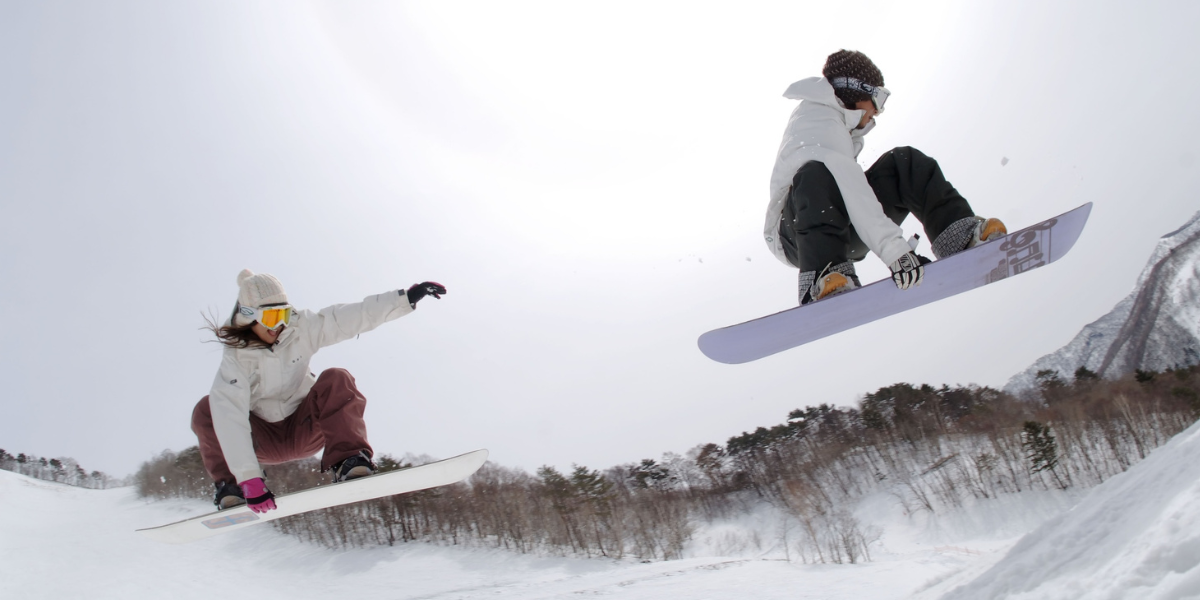
If you love snowboarding the park, or want to progress and get better at hitting features and jumps, look for a snowboard designed for freestyle riding and the park. These snowboards are designed with more flex, to bend when you hit boxes and rails – a more forgiving feeling when you make contact, where a stiffer snowboard would feel more abrasive and harder to balance.
I can definitely feel the difference between a stiffer, all-mountain snowboard and a park board when I jump up onto a rail or a feature with a curved surface. Rather than feeling like I’m slamming into it, the flex of the snowboard bends for better balance, and control, and direction. If you want to progress in the park I highly recommend getting a snowboard designed for it!
Features
- Best for: Park riding, jumps and freestyle
- Benefits: More control when making contact with features
- Twin shape
- Flex: Soft
- Camber or rocker: makes the board feel more responsive and energetic
Freeride Snowboards
If you love black diamond runs, backcountry and technical riding, look for a freeride style snowboard. This snowboard design feels the most natural to snowboarders who love carving and feeling in control as you speed down a steep section. The stiffer design helps you maintain speed without feeling wobbly. If you’re riding with speed demon friends, this snowboard design can help you keep up.
Features
- Best for: Steep runs, blacks, carving, powder days
- Benefits: Control and precision
- Shape: Direction
- Flex: Stiff
- Camber
Alpine Snowboards
Another option for snowboarders who love carving is an alpine snowboard design. These are the types of snowboards that you’ll see competitive downhill snowboarders riding as they quickly change direction and make tight turns around the flags. If that’s your style, this is the snowboard for you.
Features
- Best for: Downhill racing, groomed runs
- Benefits: Maintain speed and control through tight turns
- Shape: Narrow, directional
- Flex: Stiff
- Full camber
Powder Snowboards
Powder days are absolutely magical! Drawing lines in the fresh snowfall is a blissful feeling that we’ll take anytime we can get it. Powder days also provide a different feeling and experience than riding hard packed snow. Just a few inches of new snow on the runs can provide a totally different experience than a groomed run, and having a powder board under your feet can make all the difference.
These are the features to look for while shopping for a snowboard designed for powder days. A few key design features help you float through the powder, keep your speed, and prevent you from getting stuck.
Features:
- Best for: Powder days
- Benefits: Helps you float through powder, avoid slowing down and getting stuck
- Shape: Tapered directional
- Flex: Medium-stiff
- Swallowtail design helps you float
- Rocker: Floating, playful feeling
- Shorter length
- Wider board

Splitboard Snowboards
Each year we’re seeing more splitboard snowboard designs hit the market. These snowboards are designed to break apart into skis with your feet facing forward to tour uphill, before switching back to the snowboard stance and riding down the mountain. You’ll see women taking this style snowboard with them in the backcountry.
During the pandemic while ski resorts were closed, we saw women using splitboards to climb the mountain without the help of a ski lift, and getting their turns in while the rest of us cried. (Or was that just me?)
Features
- Best for: Backcountry and touring
- Benefits: Ride without a ski lift
- Shape: Directional freeride, nose is longer than the tail
- Flex: Medium-stiff: Stiffer tail, softer nose
| Snowboard Type | Best For | Benefits | Shape | Flex |
|---|---|---|---|---|
| All-Mountain | Groomers, tree runs, light powder | Balanced, versatile, one-board quiver | Directional or directional-twin | Medium |
| Park | Jumps, rails, boxes & other features | Playful, forgiving | True twin | Soft-Medium |
| Freeride | Steep terrain, technical lines, carving | Power, control, stability | Directional | Medium-Stiff |
| Powder | Deep snow, snow days | Float | Tapered directional, long nose, short tail | Medium-Stiff |
| Carving/ Alpine | High-speed carving, groomers, downhill racing | Extreme edge hold, fast transitions, precision | Narrow, directional | Stiff |
| Splitboard | Backcountry touring | Converts to skis for uphill | Directional freeride | Medium |
Wondering what snowboard size is best for you? Here’s what you need to know.
The Difference Between Men’s and Women’s Snowboards and Stance
Snowboards designed for women take into account women’s lower center of gravity, small boot sizes, and stance width. Having a lower center of gravity affects balance and turn initiation. Selecting a snowboard with softer flex and a hybrid camber profile may work best with your body type.
Because women’s boot sizes are typically smaller than men’s, we don’t need as wide of a snowboard. And since women on average are shorter than men, our snowboard stance isn’t as wide, so you’ll want to set your bindings closer together than your guy friends.
Many women also find that a duck stance is more comfortable, with both feet set to have the toes turned out at an angle. I find this to be true and have always rode with a duck stance.
Best Snowboard Sizes for Women
Length
Shorter snowboards are easier to control, while longer snowboards offer more stability and make it easier to float through powder. Generally, women should look for a snowboard length that’s between 138 cm – 152 cm, while also considering your height and weight. We included a table below to match up your height, weight, and recommended snowboard length.
Width
When shopping for a snowboard and looking at the width, look for a snowboard that fits your boot size. You can go with a standard width for women’s boot sizes 6-9, and a mid-wide snowboard for women’s boot sizes 10 and over.
Volume
If you find it difficult to turn the snowboard you’re currently riding, the volume might not align with your body type. Short, wide powder snowboards can be great for women who want a snowboard that’s more responsive and easier to turn. This design is better for our lower center of gravity and height.
My guy friend once gifted me a beautiful new snowboard, but it was too stiff, long, and heavy for me. I could barely get it to turn as I threw my body weight around. The tail wouldn’t respond and I would quickly wash out. It also felt super heavy on the chair lift, straining my knees and ankles. After two runs I brought it back to the car and swapped it out for my go-to snowboard that was shorter, lighter, and had more rocker. The right snowboard design makes all the difference!
Snowboard Sizing Chart for Women
| Height | Weight | Recommended Snowoard Length |
|---|---|---|
| 4’10” – 5’1″ | 90-110 lbs | 138 – 144 cm |
| 5’2″ – 5’4″ | 110-130 lbs | 142 – 148 cm |
| 5’5″ – 5’7″ | 125-150 lbs | 146 – 152 cm |
| 5’8″ – 5’10” | 140-170 lbs | 150 – 155 cm |
| 5’11” – 6’0″ | 160-190 lbs | 153 – 158 cm |
The Difference in Camber Profiles
When you hear snowboard designs described as “camber,” “rocker,” or a hybrid version of each, they’re talking about the different profiles of the snowboards. If you lay the snowboard on the floor, you’ll see which parts of the snowboard bends: between the nose and center, the center and the tail, and just at the nose and tail. The camber profile is what makes the difference between a snowboard designed for powder or the park, and everything in between.
Snowboard Camber Profiles:
- Camber: Best for stability, pop, precision, freeride, carving
- Rocker: Best for float, forgiveness, powder, beginners
- Flat: Best for stability, all‑mountain riding, park
- Hybrid: Best for versatility, women who ride mixed terrain

How to Shop for Bindings and Boots
Bindings and boots matter as much as the board. Your snowboard matches your riding style, and your boots are designed the same way.
- All-Mountain Snowboard: Medium stiff boots and medium bindings
- Park Snowboard: Soft boots and soft bindings
- Freeride: Stiff boots and stiff bindings
How to Shop for Women’s Snowboard Boots
The main difference between women’s and men’s snowboard boots is how the heel of the boot fits. Since women typically have narrower heels than men when compared to foot length, they need a boot that has a narrower heel grip and pocket. Without this, you may find your heel lifting up out of your boot as you shift to your toe edge.
Tips for Women on Setting Up Your Snowboard Stance
Since we’re typically shorter and have wider hips than men, a snowboard stance that is narrower and slightly duck foot, with toes pointed out at an angle can feel more natural. When setting up your bindings, take a look at the binding highback. This is a support piece on the back of the snowboard binding, and goes behind your calf. Setting the binding highback to be slightly forward leaning can help improve your turns by giving you more leverage to put pressure on your edge.
- Slightly narrower stance
- Slightly more duck stance
- Slightly more forward lean
With these three adjustments your knees can feel better, you may feel your balance improve, and your turns may feel stronger and more responsive.
Snowboard Recommendations by Skill Level
Here’s general guidance on snowboard designs and features to shop for, based on your skill level.
Beginners
- Design: All‑mountain or freestyle
- Flex: Soft to Medium
- Profile: Rocker or hybrid
Intermediate
- Design: All‑mountain or freeride
- Flex: Medium to Stiff
- Profile: Hybrid camber
Advanced
- Design: Freeride, powder, or alpine
- Flex: Medium to Stiff
- Profile: Camber or camber‑dominant hybrid
Common Mistakes Women Make When Buying Boards
- Buying too short
- Buying too soft
- Ignoring width
- Not matching boots/bindings
- Choosing a park board for all‑mountain riding

FAQ for Women Buying a Snowboard
Do women need women-specific boards?
Not always, but women-specific boards are designed with narrower waist widths, lighter cores, and flex patterns that match women’s biomechanics. They make riding more comfortable and responsive for most women, especially those with smaller boot sizes.
Can women ride men’s boards?
Yes, but only if the sizing works. Women with larger boot sizes (10+) may benefit from men’s boards. However, most women find better fit and performance with boards designed specifically for them.
Should women size down when buying a snowboard?
Not necessarily. Board length should match height, weight, and riding style. Women often ride slightly shorter boards for maneuverability, but sizing down too much reduces stability and float.
Is a stiffer board harder to ride?
Yes, stiffer boards require more strength and precision. Beginners should start with softer flex (3–5), while advanced riders may prefer medium-stiff to stiff boards (6–8) for control and stability.
What flex is best for beginners?
Softer boards (3–5 flex) are best for beginners. They’re forgiving, easier to turn, and less punishing when learning fundamentals.
What snowboard type is best for women who ride mostly groomers?
All-mountain boards are ideal. They balance stability, versatility, and ease of use, making them perfect for resort riding.
What snowboard type is best for women who ride trees and powder?
Powder boards or freeride boards with rocker noses and medium-stiff flex. They float better and maneuver easily in tight terrain.
Can women use splitboards for backcountry riding?
Absolutely. Women’s splitboards are designed with lighter cores and narrower widths, making uphill touring and downhill riding more efficient.
What’s the difference between camber and rocker for women riders?
Camber provides stability and pop, while rocker offers float and forgiveness. Many women’s boards use hybrid profiles to balance both.
Women’s Snowboard Buying Guide Summary
It’s recommended that women prioritize fit, flex, and terrain match when buying a snowboard. Women-specific boards often provide the best performance, but sizing and riding style matter most. And don’t forget to take our tips to match your boots and bindings, too!
See if your school made the list: 13+ Best Colleges and Universities for Skiers and Snowboarders






Leave a Reply